Pressure relieving latex mattress
Discover how a latex mattress paired with an adjustable bed enhances comfort by relieving pressure and supporting spinal alignment.

Pressure Relieving Latex Mattress: How Adjustable Beds Multiply Comfort
A latex mattress paired with an adjustable bed base reduces pressure points through natural contouring and strategic positioning. Research shows latex can reduce peak pressure by 35% compared to foam, while adjustable bases at 12-degree incline decrease awakenings by 4% and increase deep sleep by 5%, creating optimal conditions for restorative rest.
At a Glance
• Latex mattresses maintain 96.1% of surface area in low-pressure zones versus 91.8% for standard polyurethane foam
• Medium-firm mattresses show 55% improvement in sleep quality compared to participants' own mattresses
• Adjustable bed users report 60% daily usage rate with market projected to reach $9.6 billion by 2034
• Proper support requires slats spaced no more than 3 inches apart to maintain latex integrity
• Medicare Part B covers adjustable beds when medically necessary, paying 80% of approved amounts after deductible
A pressure relieving latex mattress paired with an adjustable bed base addresses the two biggest sources of sleep discomfort: peak body pressure and poor posture. By combining the natural contouring of latex with motorized position changes, sleepers can reduce tossing, support spinal alignment, and wake up feeling genuinely rested.
This guide explains the science behind latex mattress pressure relief, compares latex types, and shows how adjustable bed positions amplify those benefits.
Why Does Pressure Relief Matter for Healthy Sleep?
"The primary purpose of a mattress is to support the sleeper's posture and maintain the body's normal and neutral postural position by adjusting the normal spinal alignment according to the body curvature to distribute weight uniformly." That definition, drawn from a clinical review on therapeutic mattresses, captures why pressure relief is so important.
When a sleep surface fails to distribute weight evenly, high-pressure zones form at the shoulders, hips, and sacrum. Over time, those zones can:
- Trigger frequent position changes that fragment sleep
- Restrict blood flow and tissue oxygenation
- Increase discomfort for people with chronic pain or mobility limitations
Mattresses are among the most important types of bedding because they support a sleeping person's body while ensuring comfortable sleep. Consumer research confirms this priority: "Consumers are coming to recognize sleep's contribution to overall health and the direct relationship between quality sleep and other areas of holistic health," notes a 2023 US Pillows and Mattresses Market Report.
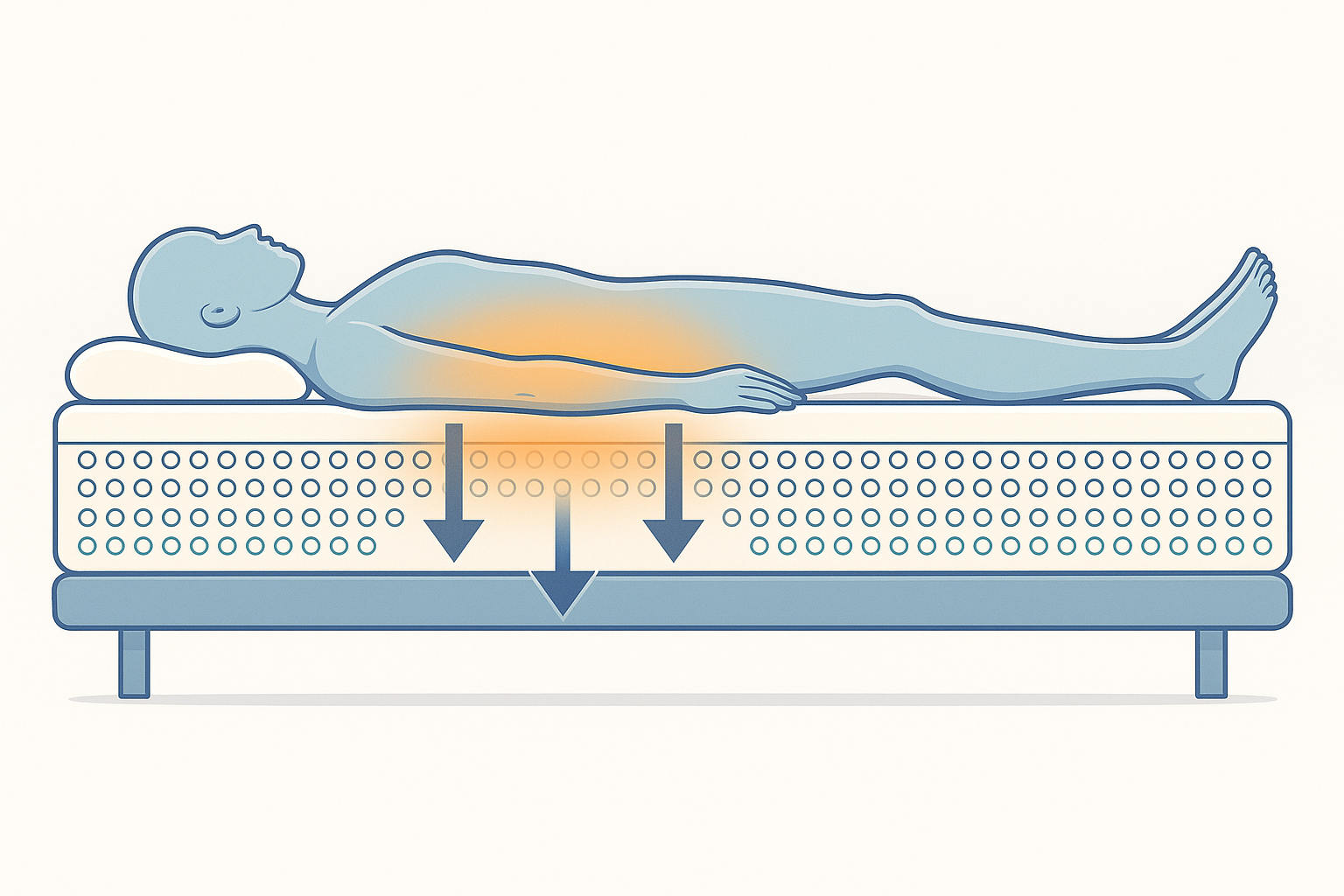
Latex, combined with an adjustable base, targets both problems at once. The mattress spreads contact pressure across a larger surface area while the base lets sleepers fine-tune their posture throughout the night.
How Does Natural Latex Distribute Body Weight?
Natural latex is made from the sap of rubber trees. The sap is collected, whipped into a foam-like consistency, and baked. The resulting open-cell structure behaves like millions of tiny springs, each responding independently to the body above it.
Peer-reviewed pressure mapping confirms the effect. A study published in the Journal of Chiropractic Medicine found that a latex mattress is able to significantly reduce peak body contact pressure on the torso and buttocks by up to 35.1% compared with polyurethane foam mattresses. The same research showed that latex maintained 96.1% of its surface in a low-pressure range, compared with 91.8% for standard foam.
That pressure-spreading ability explains why clinicians sometimes recommend latex for patients at risk of pressure sores. Talalay latex's lighter and softer consistency encourages pressure relief, making it especially suitable for comfort layers.
Talalay vs. Dunlop: Picking the Right Layer
Both Talalay and Dunlop latex start as frothed rubber-tree sap poured into a mold. Their manufacturing processes diverge from there, which affects feel and function.
| Attribute | Dunlop Latex | Talalay Latex |
|---|---|---|
| Density | Higher, firmer | Lower, softer |
| Feel | Supportive, even weight distribution | Plush, cushioning |
| Best Use | Support cores | Comfort layers |
| Durability | Excellent | Very good |
Dunlop latex is firmer than Talalay, which enhances its durability. The denser latex evenly distributes weight and supports spinal alignment, making it ideal for the base layer of a mattress. Talalay latex has a plush, cushioning feel that gently cradles the body yet remains responsive enough to facilitate movement.
Many premium latex mattresses combine both types: dense Dunlop reinforces the support core while soft Talalay cushions the comfort system.
Does Latex Lower Peak Pressure Better Than Foam?
Yes. Side-by-side comparisons consistently favor latex over standard polyurethane foam for pressure distribution.
| Metric | Latex Mattress | Polyurethane Foam |
|---|---|---|
| Peak pressure reduction (torso/buttocks) | Up to 35.1% lower | Baseline |
| Low-pressure surface area | 96.1% | 91.8% |
| Suitability for pressure-sore risk | Recommended | Less optimal |
Latex mattresses may be a suitable option for patients who are at risk for pressure sores, according to the same Journal of Chiropractic Medicine study.
A systematic review of 39 articles in the Journal of Orthopaedics, Traumatology and Rehabilitation concluded that medium-firm mattresses promote comfort, sleep quality, and spinal alignment. The review identified low back pain as a major contributor to poor sleep and noted that medium-firm surfaces effectively reduce pain for many individuals.
Key takeaway: Latex's cellular structure keeps more of the body in a low-pressure zone, which can translate into fewer position changes and deeper sleep.
Why Do Adjustable Bed Positions Multiply Pressure Relief?
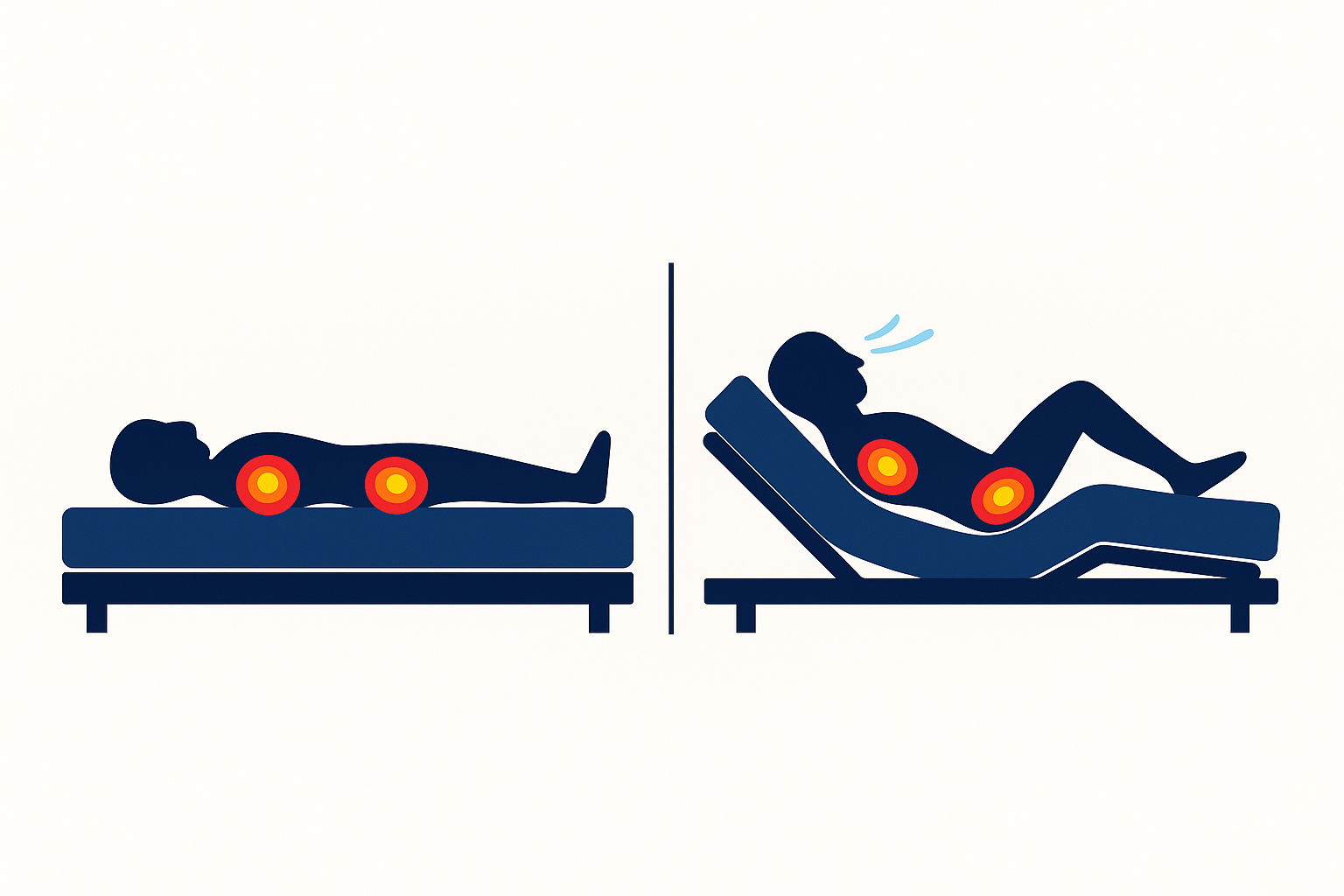
Elevating the head, raising the knees, or combining both positions changes how gravity acts on the spine and soft tissues. That redistribution can reduce interface pressure at bony prominences while opening airways and easing circulatory strain.
A home-sleep study conducted by SleepScore Labs analyzed over 1,000 nights of data. Participants who slept with the upper body at a 12-degree incline experienced:
- A 7% reduction in snoring duration
- 4% fewer awakenings
- A 5% increase in time spent in deep sleep
Participants also reported feeling more rested and experiencing better sleep quality in the inclined position.
Clinical crossover research on trunk-elevating beds found that trunk-elevating beds reduce the supine apnea-hypopnea index, a key measure of obstructive sleep apnea severity. Both trunk-elevating and side-tilting beds delayed the next obstructive respiratory event, suggesting that positional adjustments can complement pressure-relieving mattresses for respiratory and circulatory benefits.
Market data underscores consumer enthusiasm: 60% of adjustable-bed users report using the adjustment features daily. The global adjustable bed frames market is projected to grow from USD 4.5 billion in 2024 to USD 9.6 billion by 2034.
Supporting Latex on an Adjustable Frame
Not every adjustable base works well with a latex mattress. Metal grids or wire supports can allow the mattress to sag between gaps, undermining both comfort and longevity.
For optimal support, follow these guidelines:
- Choose a foundation with slats spaced no more than 3 inches apart (2.75 inches is ideal)
- Look for a solid plywood or particle-board deck with a polyester fiber layer to prevent moisture buildup
- Avoid value bases that rely solely on metal grids
- Expect to invest $1,500 or more for a high-quality adjustable platform from reputable brands
Proper support preserves the mattress's pressure-relieving properties and prevents premature sagging.
From Back-Pain to Ulcer Prevention: Clinical Insights
Medium-firm mattresses have a strong evidence base for chronic pain management. A systematic review reported significant improvement of sleep quality of 55% with mid-firm mattresses compared with participants' own mattresses, according to a 2002 study by Jacobson et al.
Mattresses with an air overlay may also improve pain and sleep quality in those with chronic low back pain, though latex offers similar contouring benefits without the complexity of air-cell systems.
For pressure-ulcer prevention, clinical guidelines from NICE recommend reducing or relieving pressure on bony areas. One of the best ways of preventing a pressure ulcer is to reduce or relieve pressure on areas that are most likely to develop pressure ulcers, such as bony parts of the body. Pressure-redistributing equipment, including special mattresses, can spread or relieve pressure regularly.
A randomized evaluation across 11 NHS hospital centers enrolled 1,972 patients and found no statistically significant difference in new pressure-ulcer rates between alternating-pressure overlays and mattress replacements. However, mattress replacements were more cost-effective and associated with higher patient satisfaction.
Key takeaway: Whether the goal is chronic-pain relief or ulcer prevention, a medium-firm latex mattress on an adjustable base offers a practical, evidence-supported solution.
Will Medicare Cover Your Adjustable Bed or Pressure-Relief Mattress?
Medicare Part B covers hospital beds as durable medical equipment (DME) when a physician documents medical necessity. Coverage criteria include:
- The patient's condition requires positioning not feasible in an ordinary bed
- Special attachments are needed that cannot be used on a standard bed
- Frequent or immediate position changes are required
A semi-electric hospital bed is covered if the patient meets one of the criteria for a fixed-height bed and requires frequent changes in body position or has an immediate need for a change in body position.
However, Medicare typically does not cover total-electric hospital beds (where height adjustment is considered a convenience feature) or advanced comfort features like massage, heat therapy, or premium pressure-relief mattresses.
Cost-sharing details:
- Medicare pays 80% of the approved amount after the deductible is met if suppliers accept assignment
- Patients are responsible for the remaining 20% coinsurance
- Out-of-pocket costs for premium hospital beds with extra features can range from $500 to $5,000 or more
Documentation problems are common: insufficient documentation accounted for 82.6% of improper payments for hospital beds and accessories during the 2024 reporting period, with a projected improper-payment amount of $16 million.
If you believe you qualify, work closely with your physician to ensure the prescription and supporting records clearly establish medical necessity.
Choosing an Organic Latex Mattress & Local Support
When shopping for an organic latex mattress, look for third-party certifications that verify material purity and manufacturing standards:
- GOLS (Global Organic Latex Standard): Confirms organic latex content
- GOTS (Global Organic Textile Standard): Certifies organic cotton and wool components
- GreenGuard Gold: Tests for low chemical emissions
- eco-INSTITUT: Verifies non-toxic composition
Products bearing these labels meet stringent standards for certified organic and natural materials, ensuring pure, healthy, and non-toxic sleep.
Beyond certifications, consider the value of local expertise. 53% of adults prefer to feel a mattress in person before purchasing. A showroom visit lets you test firmness levels, ask questions, and arrange professional delivery and setup.
Electropedic Beds has specialized in electric adjustable beds since 1964. The company offers Latexpedic mattresses in multiple thicknesses (7", 10", 12") and firmness levels (Soft, Regular Firm, Extra Firm, Ultra Firm), all backed by a 20-year limited warranty. As a family-owned manufacturer with showrooms in Southern California and Arizona, Electropedic provides local delivery, installation, and lifetime service, which sets it apart from mail-order alternatives.
Key Takeaways: Sleep Better Tonight
Combining a pressure-relieving latex mattress with an adjustable bed base offers measurable benefits:
- Lower peak pressure: Latex can reduce contact pressure by up to 35% compared with standard foam
- Better sleep metrics: A 12-degree incline has been shown to reduce awakenings and increase deep sleep
- Clinical support: Medium-firm surfaces improve sleep quality and reduce back pain for many individuals
- Customizable comfort: Adjustable positions let you fine-tune support for reading, recovery, or rest
"Our Latexpedic Mattresses are the most comfortable mattress in the World!" declares Electropedic. With 61 years of expertise, an A+ BBB rating, and a full range of adjustable-bed options, Electropedic is well positioned to help you find the right combination of latex comfort and adjustable support.
Frequently Asked Questions
How does a latex mattress relieve pressure?
A latex mattress relieves pressure by distributing body weight evenly across its surface, reducing peak pressure points at the shoulders, hips, and sacrum. Its open-cell structure acts like tiny springs, providing support and comfort.
What are the benefits of combining a latex mattress with an adjustable bed?
Combining a latex mattress with an adjustable bed allows for customizable sleep positions, which can enhance pressure relief, improve spinal alignment, and reduce snoring and awakenings, leading to better sleep quality.
What is the difference between Talalay and Dunlop latex?
Talalay latex is softer and more cushioning, making it ideal for comfort layers, while Dunlop latex is denser and firmer, providing excellent support for the mattress core. Both types offer unique benefits for different parts of a mattress.
Does Medicare cover adjustable beds and pressure-relief mattresses?
Medicare Part B may cover adjustable beds if a physician documents medical necessity, but typically does not cover advanced comfort features like massage or premium pressure-relief mattresses. Patients should ensure proper documentation to qualify.
Why choose Electropedic Beds for a latex mattress and adjustable bed?
Electropedic Beds offers Latexpedic mattresses with multiple firmness options and adjustable beds, backed by a 20-year warranty and local service. Their expertise since 1964 and commitment to customer satisfaction make them a reliable choice.
Sources
- https://spindlemattress.com/blogs/mattress-blog/latex-vs-polyurethane-research
- https://www.ncbi.nlm.nih.gov/books/NBK599022/
- https://market.us/report/adjustable-bed-frames-market/
- https://www.jstage.jst.go.jp/article/ijae/14/2/14_111/_pdf
- https://store.mintel.com/report/us-pillows-and-mattresses-market-report-2023
- https://sleepdoctor.com/pages/reviews/dunlop-vs-talalay-latex
- https://jorthoptraumatol.springeropen.com/articles/10.1186/s10195-021-00616-5
- https://formative.jmir.org/2022/4/e30102/PDF
- https://www.sciencedirect.com/science/article/pii/S1389945725000760
- https://sleepez.com/blog/foundations-for-latex-mattresses/
- https://www.nice.org.uk/guidance/cg179/ifp/chapter/prevention
- https://www.journalslibrary.nihr.ac.uk/hta/HTA10220
- https://www.cms.gov/training-education/medicare-learning-networkr-mln/compliance/medicare-provider-compliance-tips/hospital-beds
- https://expresshospitalbeds.com/pages/hospital-bed-buying-guide
- https://www.plushbeds.com/
- https://www.electropedic.com/Adjustable-Beds.html